
Why#
I tried Claude Code. Codex. Pi. Kiro. Kimi Code. Copilot. Antigravity. Cursor. OpenCode. Superpowers. Ponytail.
And while we can feel the models getting better and better, I couldn’t help but hate the “standard” LLM-driven workflow:
- Prompt the coding agent about a feature
- Wait for it to gather context and respond
- Start iterating in the chat, respond to questions one by one, with a shitty interface
- Once the feature is well specced, let the agent build
- Be disappointed by the resulting code: too complex, faulty, poorly organized
- Add more skills, prompts, context, and rules, and pray it goes well
So I sat down, and just like I did for GHOST, I thought about how I wanted to
interact with an LLM:
- Asynchronous. I don’t want to sit down for 20 minutes while an LLM runs tests.
- Efficient. What I hate over everything is having to go back and play Q&A after an LLM has spewed a 10k LoC PR. I want good code from the start, following my specs, without any uncertainty.
- Intent. If I were to stop looking at the code, at least my decisions and directions should be stored in the repository, since those are what actually generated the code.
- Readable. Walls of text in TUIs don’t do it for me. I want context, hyperlinks, graphs, formatting, and visual hierarchy.
- Robust. LLMs change every week. Harnesses too. It should be a workflow that’s understandable from just reading text files in the repo.
- Mobile. I don’t want to be glued to my PC, waiting for an agent to reply to me. I want to be able to evaluate specs and features on the go.
All those things would also have the advantage of working particularly well with local models:
- Even if running a model is a bit slower locally, it’s ok if it’s asynchronous
- Being strongly opinionated about the code and workflow pushes agents in the right direction
What#
So that’s how I ended up creating uraeda:

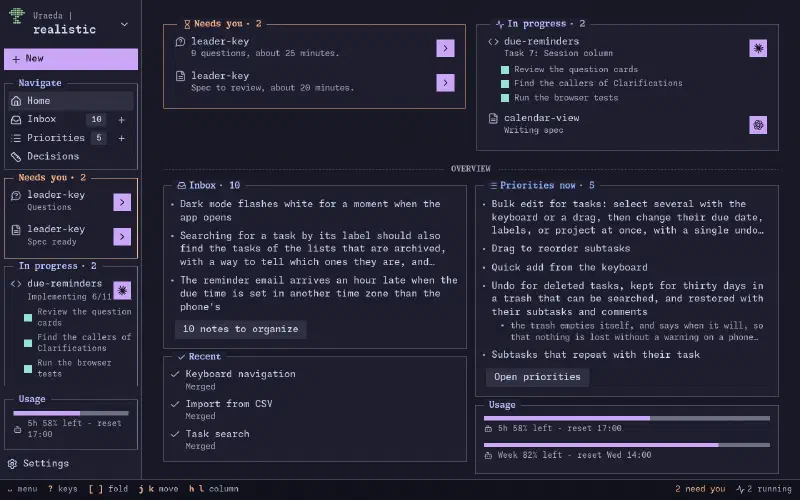
It’s a git-driven workflow. All stable state gets committed to git:
First, I create a proposal explaining the big picture of the feature or change I want to make
proposal.mdThe agent works autonomously, in-depth, and researches the current state of the codebase, possible issues with the feature, and how it’s implemented in other projects
discovery.mdIf needed (it often is), the agent asks for clarifications: a list of questions to clarify anything that’s unclear about the proposal and take important engineering decisions. All with necessary context.
clarifications.mdAfter I respond to the clarifications, the agent creates a spec. It includes user stories, important decisions to save, edge cases, mockups, …
spec.mddecisions/[topic].mdAt this point, I will have a few comments, and I’ll ask for a v2 of the spec
spec-review.mdOnce the spec is validated, the agent creates a step-by-step implementation plan, highlighting waves of tasks that can be developed in parallel.
plan.mdAfter the implementation, the agent issues a PR and condenses the information from all the flow in a single report, committed to the repository.
The decisions and final report are the only artifacts that stay in the repo, as they will give context beyond code for the future agents.
Locally, the server holds chat sessions and other info. But you could lose this local database and it shouldn’t be an issue. Everything that matters is in git.
I benchmarked the workflow against other harnesses, having an LLM roleplay the human in the process, and it did improve results slightly compared to raw Claude Code.
More importantly, I enjoy using this workflow to add features to my projects. It respects my time and I get to the software I have in mind faster.
There’s still tons to improve, but I’m decently happy with its current state and I’m making it officially v1.0.
Try uraedaIt’s complicated#
I still have a love-hate relationship with LLMs and their impact on coding.
On the one hand, I have finally been able to build software I’ve always wanted for myself. I have tons of vibe-coded apps I use daily, from my own restaurant recommendation system to a bicycle parking spot search engine. Tons of minimal, extremely fast, simple to use micro-apps. And I can also envision building bigger, better apps than I ever did.
I can even produce frontends I’ve always imagined but was never able to write as I hate JavaScript!
On the other hand, all the feeling of accomplishment, success, and flow state I had when writing code is gone.
I enjoy seeing the final result, and I enjoy having great, tailor-made software.
But I hate what it’s done to me. I used to write Rust serverless functions with sub-10ms startup time. I used to have 100% code coverage on the backends I developed at my company, all by hand. I used to produce high quality code that people loved working with.
It’s all gone. I don’t even know what the code looks like anymore. Half of it is written in languages I don’t even enjoy, and wouldn’t be able to evaluate since I didn’t have time to develop a strong taste for it.
I’ve become a project manager with a strong technical background.
Next steps#
I’ll now be using uraeda to work on personal projects:
- A turn-based competitive strategy game where both players play simultaneously
- A chat app with modular UI that can easily be self-hosted, federated, and fast
- Making a less addictive UI for reading Reddit/Bluesky, optimized for e-ink devices
- A Japanese learning system that picks up from my 12,000 Anki flashcards into something more interactive and focused on grammar
- A Go coach that analyses my games and creates Tsumego relevant to the errors I often make
It’s hard to find time as a dad of two young kids, doing all the cooking, cleaning, transportation, and of course hours of active time together daily. I hope uraeda will help me at least make some progress on those projects, here and there, when I have a few minutes to read the questions.