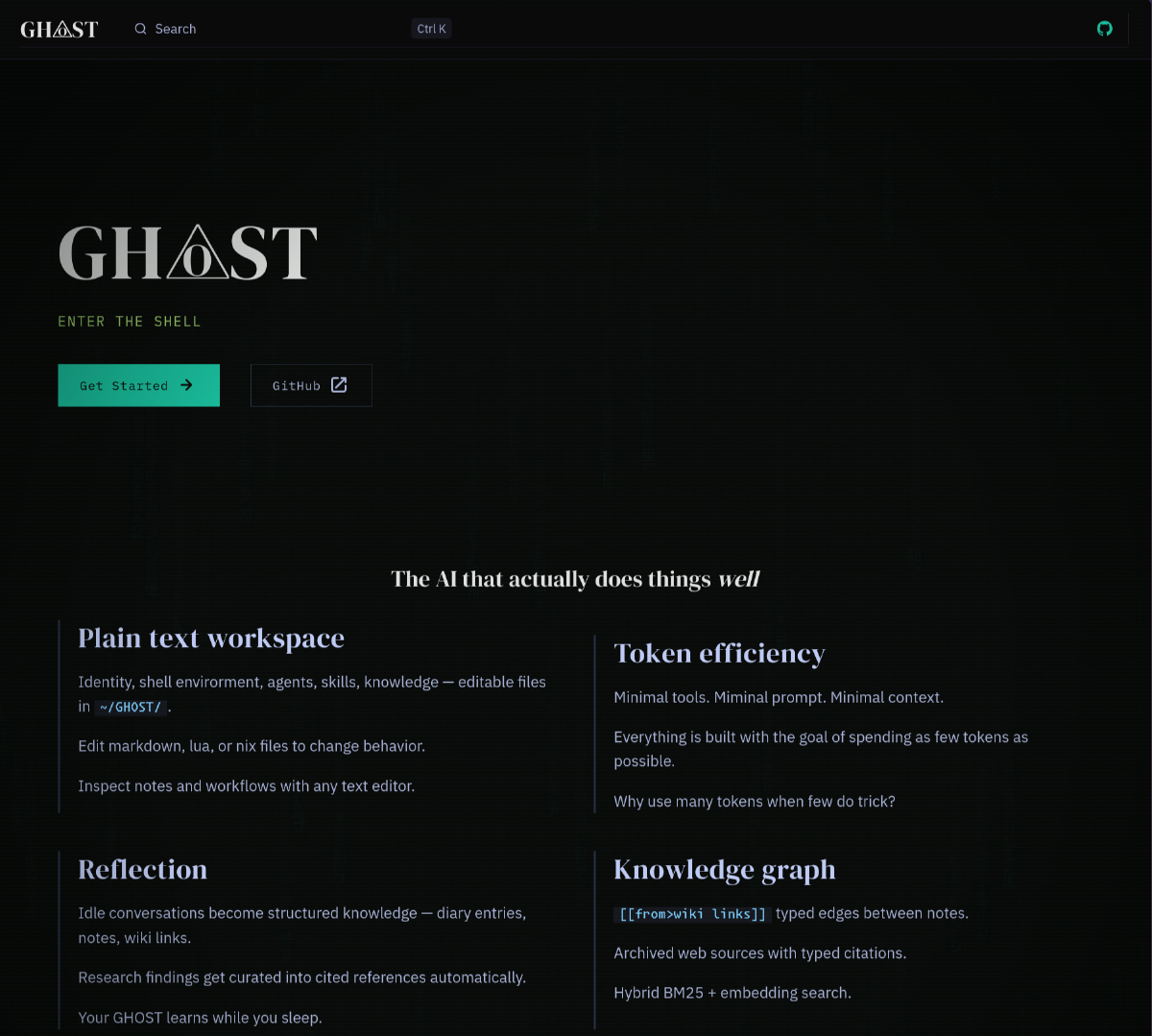
It’s been about two months since I started working on GHOST.
The concept is good: “OpenClaw” in Rust, with Nix as the only dependency, batteries included. An AI assistant that my mom could use and find useful instantly instead of relying on it extending itself haphazardly.
For the past month, me and my wife have been daily driving it as an AI agent and it’s worked mostly well.
But I’m giving up.
Wrong vibes#
When I started the project (T-KOMA), I went fast. I had decent core features, but I made some design mistakes that were compounding and hard to fix with LLMs.
So I re-started from scratch with GHOST, and I’m now at a similar point.
I realize this is a feature, not a bug.
LLMs give you the power to move at the speed of light. You feel like you’re on top the world. You iterate through your backlog, quickly test the features, and move on.
But over time mistakes add up. You discover problematic abstractions. You discover bugs at foundational levels that you are not sure you can fix reliably. You encounter issues you didn’t even know could exist like SQLite database corruption.
As you use the software more and more, you discover small bugs that really should never have been there in the first place. Every usage turns into a debugging session. All previous features have to be questionned.
And you realize there are 50 similar projects that sprouted up in the two weeks it took you to get there.
You are faced with three options:
- Start again from scratch with new knowledge
- Keep fighting the 50k+ LoC codebase that grew out of control
- Give up and use one of the other projects
I tried all three, in order.
What I learned#
The thing is, my GHOST is decent.
It is legitimately better than the web apps from top LLM providers. Now, my wife uses it over Gemini as she finds it provides higher quality responses. I also learned how many moving parts an AI agent has that still is not fully solved.
Let’s review them quickly.
Prompt engineering#
Sycophancy and hallucinations are not bugs: they are a core part of LLMs. They are built that way because their training data is all about pleasing users and solving problems.
It’s harder than it looks to:
- Make LLMs honest
- Make them learn to fail instead of gaslighting the user
- Make them give up when they don’t find a satisfactory response
- Make sure they properly cite their sources and never invent information
- Have them look for good, authoritative sources instead of relying on second hand snippets or its own “knowledge”
I had to spend a few millions of tokens and hours of end-to-end testing with LLMs to find the right wording that worked with all big models.
And my model started acknowledging bugs and low quality data instead of pushing through. It started providing in-depth, well-sourced comparisons when asked about products. It sounded less like a vending machine and more like an actual assistant.
The thing is, modern models are very good at following instructions. When given clear workflows that work against their biases they end up producing much higher quality output than “raw” usage.
The problem is that AI peddlers don’t want higher quality output. Instead of focusing on long-term positive outcomes for humans, which it should, it focuses on short term gratification.
What I learned is simple: privately funded company will optimize for engagement and user satisfaction, aka, slop and brain damage.
The only way to sidestep it is to work with providers only for LLM access, and always refuse their tools and apps.
LLMs are extremely powerful systems, but the incentive in place for big companies to hasten adoptions are detrimental to their apps.
Knowledge management#
There are literally hundreds of systems out there, and I tried building my own from scratch.
While it seems to work decently… It’s far from perfect and it’s extremely hard to test without long-term usage.
That’s the issue here: in those new, fast moving feature spaces, it’s extremely hard to evaluate the quality of your implementation. There are some benchmarks already but I’m not sure they’re fully representative of how the systems actually work live.
What I learned is that I made a lot of assumptions in building a knowledge base that looked like my Obsidian vault… and I’m still not sure I got it right.
Validation is hard in the LLM space.
Extensibility#
The goal of AI agents is extensibility, but how do you achieve that?
OpenClaw was very painful on that front, being extremely reliant on brew: running poorly on linux, unable to handle version conflicts on dependencies, entirely stateful and hard to pin/diff, …
My approach with lua + nix worked better. But for bigger dependencies like pdf ingestion I ended up having to fall back to python or containers, adding an extra layer of complexity.
The more I added to the core binary, the more bloated it got with features that maybe 1% of users would care about.
For example adding .epub imports wass extremely useful for me to have natural language semantic search on the books I read, but does it deserve to be part of the agent for everyone? Clearly not.
So I needed a plugin system, which would likely be WASM if I went there. But it’s not going to happen.
Providers and pricing#
While there are hundreds of providers, performance and pricing are all over the place:
- Claude Pro offers decent value at 20$/month, but using it “freely” (through their API without Claude Code) is against the ToS
- ChatGPT Plus is OK with you using your subscription’s tokens as you wish…
but through and undocumented API. And also I’m not a big
ClosedOpenAI fan. - Google’s pricing is a mess and Gemini CLI always blocked me after 5 minutes of usage, even when I was on the pro plan
- Chinese models are getting extremely good but you have to pay per token (mostly), and prices can end up relatively high
- Running performant models locally on reasonably priced hardware is still a few years away
I still don’t have a “clean” solution. If I had to pay for a subscription or tokens for an AI agent today, I’m not sure which one I’d pick.
Security#
And finally, the reason I gave up.
My GHOST was full YOLO, with full shell access to the host.
When I started actually speccing the security… I realized it was an extreme amount of work and testing that was already getting solved by so many other tools.
And if security had been my only issue, I’d have done it. But when I’m running into small bugs daily… Adding security will just make them worse!
Keeping the good stuff#
Right now I plan to give other AI assistants a shot while using what I learned:
- Using prompt engineering to make it so the AI can’t bullshit me
- Trying external memory systems that are supposed to work well
- Relying on their extensibility system to implement the features I want (like epub import!)
But unfortunately, I feel like none of the tools popping up really offers what I had in mind with GHOST.
They all feel more like Obsidian than Notion to me: extremely extensible, but reliant on extensions. Which means new users need to find out the extensions they need as they use the software.
Not a great fit for my mom.
What’s next#
Tomorrow, I’ll do some gardening. Touch some grass.
Then I’ll think more about this post mortem.
I am sad to have spend two months on a project and just give up, but at the same time… I wrote almost zero lines of code, so it does not really feel like “my” project.
I’m not sure where software development is going. I’m not sure I like this.
But I also think the software of the future will be modular and open.
LLMs are extremely good at creating per-user custom interfaces if given a clear contract and data model.
As different users have different needs, why shouldn’t they have different UIs?
I think I’ll try working on that next.