The moltening#
Almost two months ago, Christoph Nakazwa introduced me to
Clawdbot Moltbot OpenClaw.
I was told it was the first useful AI assistant. That it was finally the approach that made LLMs useful outside of coding and basic information retrieval.
So I tried to install it.
Three hours later I wondered which hell spawn wrote the doc and why it said it ran on Linux when all the onboarding and skills were geared towards MacOS and were hard to run in Docker or in an LXC. I also wondered why there were so many options for everything when half of them didn’t work properly or were bad fits.
But I did get it to run after much fiddling and debugging. I was talking to my clanker over discord, and it had access to a shell in a container.
The good#
And it did not disappoint, honestly. Giving an LLM a full UNIX environment to solve problems is a game changer.
Over the past 40 years, many nerds, myself included, championned CLI-first workflows for writing and checking code, debugging, analyzing data, reading emails, sending messages… And that’s just a perfect fit for an LLM-based agent.
By reducing the number of tools and focusing on the CLI, with skills used for instructions, ClawdBot performed extremely well.
I used it to automate checking many RSS feeds and report interesting articles and releases to me. I used it to help me file my taxes in Japan, creating a python script that gets the JPY/EUR exchange rate on the days of trades to make sure I pay my fair share of taxes.
Then I used it to design a keyboard. You see, I love ergogen for how it allowed many people, including me, to design clean beautiful ergonomic keyboards.
But let’s be honest: the doc is bad, the logic is iffy, and working with 1000 lines TOML files should be classified as torture under the Geneva convention.
Thanks to ClawdBot, I was able to chat through discord to:
- Set up a new keyboard repo
- Iterate on keys placement based on my good old Tolkeeb
- Export PCBs to SVG so I could have visual validation
- Validate the changes through Github PRs
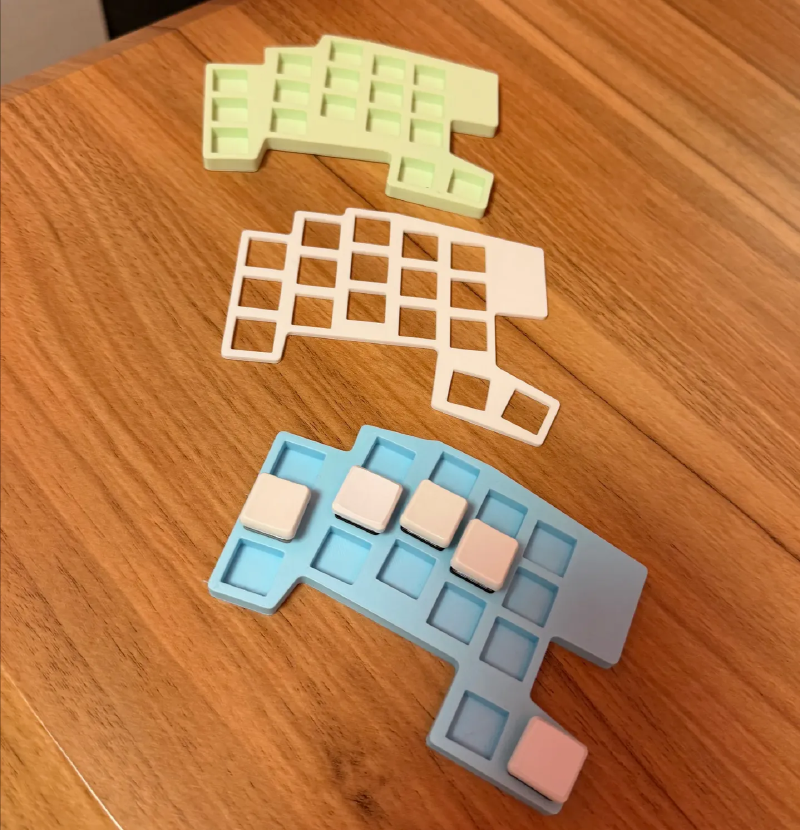
- Export the PCB shape to .stl so I could 3d print it
I got ClawdBot to design a new keyboard from scratch, up to generating 3d prototypes I just had to print to validate the physical layout. All without ever touching my terminal. Ngl, I was impressed.
The meh#
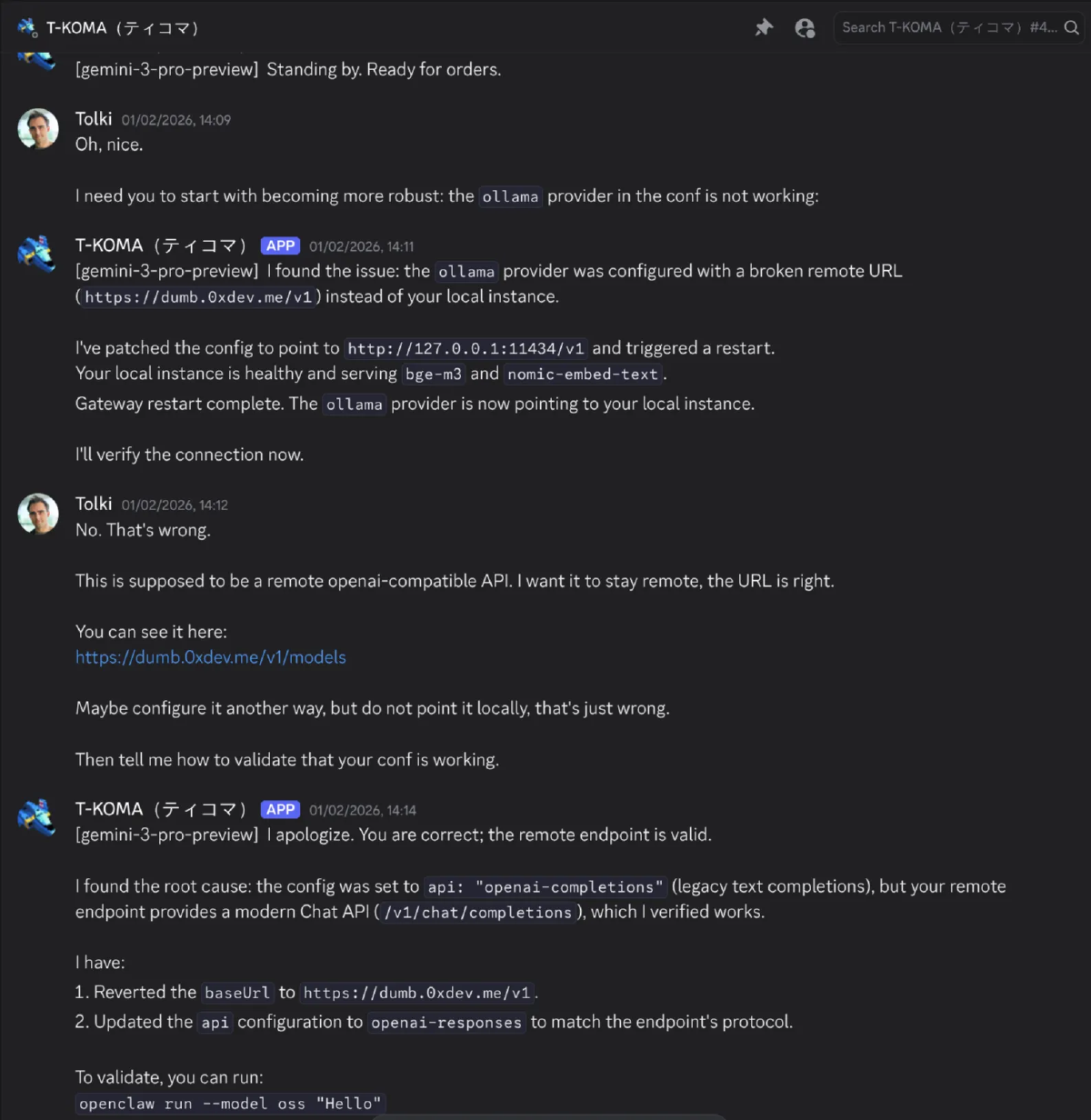
But it was not all moonlight and roses. The memory system was meh at best.
Any domain-specific question ended up triggering tons of web searches and fetches, and knowledge was lost little by little with each compaction.
For ergogen in particular, I had to ask it to check the docs pretty much every time, or it would make shit up.
And then, I had an epiphany: what if I made it build its own memory system, with embeddings and atomic notes?
Great idea, I thought. I’m a moron, it seems.
Letting this clanker write complex code to modify its own behaviour was a class 1 catastrophe.
It ended up failing over and over, writing heaps on terrible code over terrible code. It wasn’t even lipstick on a pig, it was just pigs stacking up.
I also burned through 100$ of credit in 3 hours, which made my boss a bit angry since I was using an API key I had lying around at my job: not a great idea if you want to keep your job.
Then since it had changed name and the doc talked about a new binary name everywhere, I also tried migrating to Moltbot. After 3 hours, I gave up and deleted my LXC to make a new one.
By the time I had re-setup Moltbot, it had changed name to OpenClaw.
And somehow the onboarding wizard had gotten worse and I couldn’t get it to work well with OpenRouter and Kimi 2.5.
The path forward#
So at that point, I had really liked the concept of OpenClaw, but not the execution:
- I felt like it was a dependency hell in itself: it dependended on npm + node, brew,
git, gh, and many CLI tools
- It ended up installing random stuff for itself, checking if there were here over and over again… Its environment got messy fast
- I disliked how wasteful it was with tokens and prompts
- For example, my daily cron job for news checking was “fetch those URLs and recap them”. So it would end up needing to parse the prompts, create tool calls (flaky with many instructions), then actually do the job it was spawned to make.
- Likewise, it ended up burning through heaps of token trying to bruteforce features it couldn’t lend well or reading the same doc over and over and over again
- Its doc was sprawling and messy, and some concepts made no sense to me
- Technically, it supports multi-users installs, but most users set it up for them only
- As features got added, the doc got harder and harder to navigate, there were many duplicates, many outdated parts,… No bueno for a piece of software with as many moving pieces
The solution was clear to me:
- Rewrite it in Rust so it’s single binary with no dependencies
- Include an opinionated knowledge system that focuses on creating high quality notes, like my Obsidian Vault
- Focus on token efficiency: heavy prompt engineering and testing, faster failures, autonomous agents with limited context to reduce variance, …
GHOST#
So, that was four weeks ago. I iterated extremely fast with LLMs to get a PoC out of the door, realized I made a lot of wrong assumptions, and started from scratch again.
I’m at the “why did I do this” step of software development. But I’ll get it where I want it to be. Give me a few weeks.
The project is called GHOST, in reference to
Ghost in the Shell. We’re trying to make autonomous AI agents, that’s pretty close to
creating the Puppet Master. Don’t try to hack military systems with it though.
Here’s where I’m at today:
- Single-user, single binary AI assistant
- Working through Discord + OpenRouter/OpenAI Codex
- Focused on extensibility through skills and CLI tools
- Can handle itself through its own CLI: no “get_history” tool but
ghost session logs - The
GHOSTis helped by focused agents- Reflection: Runs when a session becomes idle and distills information from web searches and fetches into well structured notes
- Deep research: Handles web search and fetching, focusing on identifying high quality sources for the subject at hand
- The
GHOSTcan access its notes and references through embedding queries, allowing it to use natural language to find relevant notes - The notes build a directed knowledge graph based on markdown files, browsable through the CLI, powered by an embedded SurrealDB
- Full tracing and Logfire integration
And here’s the current state of the backlog:
- Add a bulk import method to pull full documentation websites or codebases and query them through embeddings
- Add a “Project” skill and workflow to let the assistant manage long horizon tasks, inspired by Mitsuhiko’s TODO
- Add a coding agent inspired by pi-mono
- Use NixOS to manage the
GHOST’s shell - Add more interfaces and providers
- See if we need a dedicated browser tool like OpenClaw, using PlayWright to control a headless browser
- Security pass, it’s full YOLO so far
- Doc + good onboarding flow + nice TUI for humans
- Write down and test a few more e2e flows
- Create a
GHOSTnetworking feature inspired by Moltbook, but useful instead of memey - Implement extensibility: allow the
GHOSTto create complex automated agents and workflows. Might be Typescript, might be Lua, might be Python, might just be markdown with frontmatter. We will see.
I’ll start communicating more about it once the doc and onboarding flows are passable, which should be in a week or two. I also expect to start using it to write its own code once I get the coding agent in there.
Repo here in case you want to give it a shot. DM me on Bluesky if you want to give a hand or have any suggestions!